
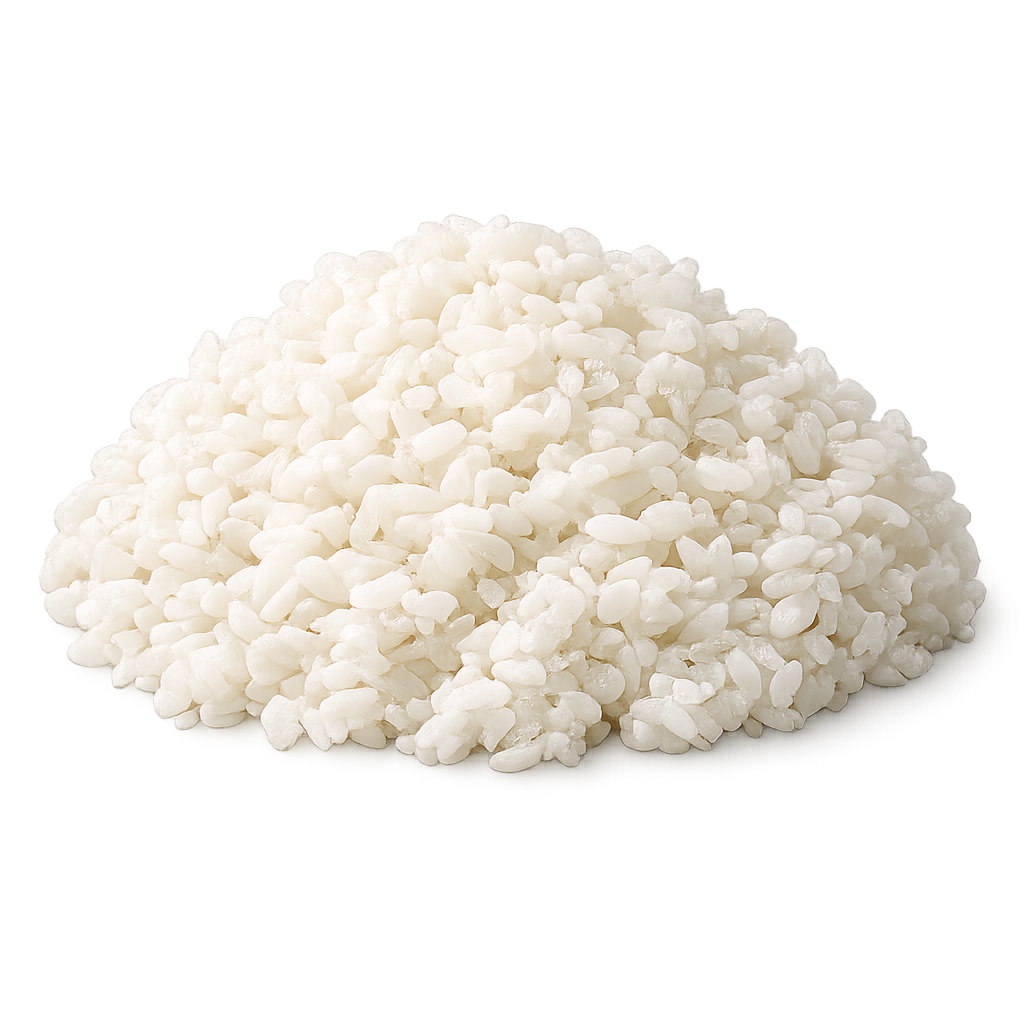
Overview
Sushi rice is cooked Japanese short-grain rice seasoned with rice vinegar, sugar, and salt for sushi preparation.
Food note
Fold the vinegar seasoning gently into freshly cooked rice without crushing the grains. Cool it rapidly to a warm room temperature and keep covered with a damp cloth while assembling sushi. Do not leave cooked rice at room temperature for extended periods Refrigerate leftovers promptly.
Pros
- Provides quick energy
- Essential base for sushi
- Naturally low in fat
Cons
- High in refined carbohydrate
- Contains added sugar
- Contains added sodium
Calories by servingShow details
| Serving | Calories | Protein (P) | Carbs (C) | Fat (F) |
|---|---|---|---|---|
1 serve100 g | 150 kcal | 2.4 g | 33.4 g | 0.2 g |
Per 50 g50 g | 75 kcal | 1.2 g | 16.7 g | 0.1 g |
Per 100 g100 g | 150 kcal | 2.4 g | 33.4 g | 0.2 g |
Per 150 g150 g | 225 kcal | 3.6 g | 50.1 g | 0.3 g |
Per 200 g200 g | 300 kcal | 4.8 g | 66.8 g | 0.4 g |
Per 250 g250 g | 375 kcal | 6 g | 83.5 g | 0.5 g |